
What if you stopped pitching your donors and started treating them like true partners in solving real-world challenges?
By sharing your institution’s priorities and challenges alongside proof of past success, this organizational update tool pairs transparency with impact to pave the way for quicker future gifts.
To start off as a testament to the effectiveness of this visit tool, a personal story of how I experienced it in action:
Years ago, my husband and I sat down with a gift officer from Lucile Packard Children’s Hospital. As donors, we fully expected to spend our lunch listening to a generic pitch for more funding. Instead, she handed us a short, personalized organizational update.
It completely changed how that lunch went. We stopped just making polite chit-chat and got deeply locked into where the hospital was going, the real hurdles they were navigating, and exactly what our past support of different initiatives actually made possible. We were so touched that the fundraiser took the time to personalize a quick report just for us as leadership annual donors. Seeing exactly how our giving connected to their bigger mission inspired us to increase our support right then and there.
A few years later, I was sitting in an Advancement Resources training at Santa Clara University when the facilitators shared a tool that looked incredibly familiar: the organizational update. It was the exact same framework Lucile Packard had used with us.
What it is: A simple and effective organization update tool
An organizational update is a simple, six-page visual handout for your one-on-one donor visits. It is NOT a dense annual report, a generic brochure, or a formal proposal. Think of it as a quick conversational roadmap that grounds your meeting and gives the donor a clean, honest picture of where things stand today.
The Advancement Resources framework breaks a donor visit down into three simple pages of the document:
Updates -- Where We Stand: Sharing recent wins or milestones for the organization to build confidence.
Unique challenges -- What We Face Today: Being transparent about the hurdles the organization is actively facing.
Opportunities and Organizational Priorities: Outlining the strategic path forward and where the focus is shifting (specifically those priorities that align directly with your strategic plan and immediate funding needs).
They call the conversation sparked by this transition "development magic," and it really is. I can attest as a donor and a fundraiser who has used in in my own professional work that it opens the door for completely organic questions. It makes it so much easier for a fundraiser to spark a deep conversation around donor motivation and funding priorities by walking through the organization update then asking questions like “As you think about these priorities, what intrigues you most?”
Closing the loop on stewardship
While that Advancement Resources framework is fantastic for cultivation, I have built upon it for my own in-house fundraising roles as well as for my clients by explicitly including a page for stewardship.
Let's be honest…the number one way we let our donors down is by failing to clearly show them where their money actually went and the impact it made. We are great at making the ask, but we often fall short on stewardship.
The last page of this document is specifically designed to fix that. I always add a dedicated page at the end of the organizational update called Your Impact - Thank you for making a difference! This is where you connect the dots. Whether they gave to a specific initiative or the general operating fund, you can use quick, easy-to-write bullet points to outline exactly what their past generosity made possible.
When a donor can see exactly what their last gift accomplished right along with current opportunities and organizational priorities, the transition to a future gift conversation doesn't feel forced. It just flows naturally.
Your free template to build an organization update (plus when to use it)
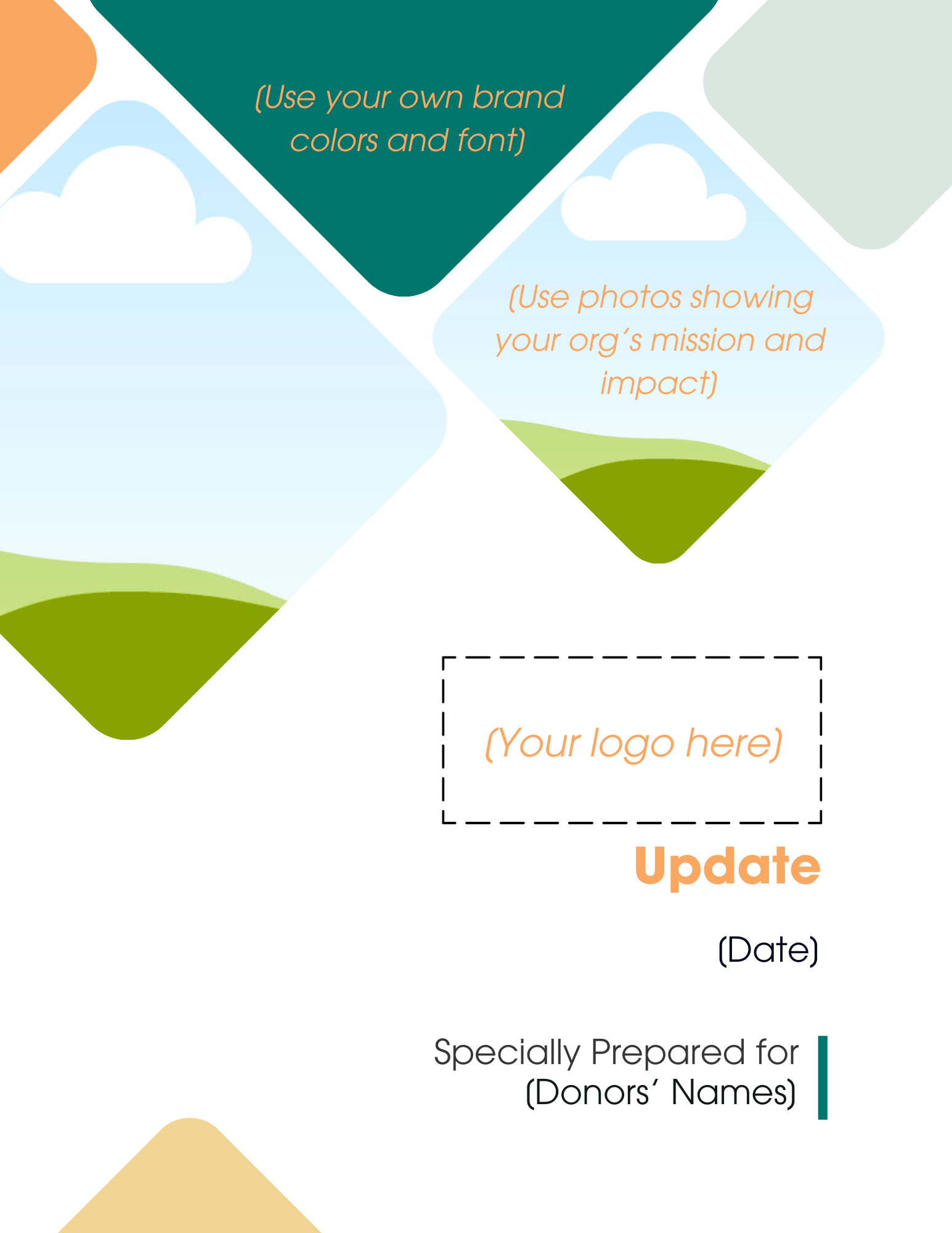
I built this free organizational update template in Canva so that you can easily customize your organization’s brand colors, logo and pictures for a curated experience for your donors and quickly drop in bullet points to inspire productive conversation.
It is designed specifically so each topic takes up only a half to three-quarters of a page of standard font text. Donors only need a high-level two or three sentences on each topic. That is more than enough during a visit to spark questions or learn more if it piques their interest to unpack a subject further. The strategy here is to keep them informed at the highest level. It gives them just a taste so they can self-select exactly what they want to discuss further or help with.
You can use this approach for managed donors or prospects at any level of your portfolio, though it is particularly effective when focused on leadership annual gift and major gift donors.
The best time to pull this out is right during a face-to-face cultivation or stewardship visit but you can also utilize it as a leave behind or send it to them digitally.
The organizational update serves as the perfect bridge between casual small talk and a real philanthropic discussion. It gives the visit an immediate purpose and makes it easy to share big updates without feeling forced.
The magic of the organizational update
Why does this specific flow work so well? Because it matches how major donors actually think when they are deciding where to invest their resources:
Donors want to back a winner: Everyone likes to support an organization on the rise that is doing great things. Leading with your milestones builds that critical momentum.
Donors want the honest truth: They are savvy. They appreciate a transparent view of the headwinds and challenges your institution is actively navigating.
Donors want to be part of the solution: They don't just want to just write a check; they want to see how their personal values align with your mission to solve real problems. When you share a challenge alongside a smart, approved plan, it shows the donor exactly how their support can make a difference.

I recently built customized versions of this template for a private university and a healthcare organization. The feedback from their gift officers was immediate. It took the pressure off "making the ask" because the document naturally fueled deeper conversations and authentic next steps.

Tips for using this with donors
Even the best handout won’t work if the meeting itself feels clunky. Fundraisers often worry that pulling out a printed packet will feel too salesy or slick.
Here is how I recommend coaching your team to run these visits:
Keep it tucked away at first: Do not lay the update on the table the moment you sit down. Once the initial small talk naturally winds down, that is your cue. Pull out the document and say: "I put together a quick update specifically for you today because I wanted to share some great news, but also be really honest about some of the hurdles we are navigating and how your past giving has made such a big difference."
Frame hurdles as an invitation to partner: Gift officers naturally want to put a positive spin on everything, but donors are too smart for that. They want the real story. Talk about headwinds as opportunities for collaboration, not a crisis. Try saying something to the effect of: "We don't expect you to solve these hurdles for us, but we treat our closest supporters like true partners. I wanted you to know exactly what we are up against as we build our next strategic plan."
Do not read it to them: Use the pages as anchors for a conversation, not a presentation.
Opt for an insider brief aesthetic: Do not print this on glossy, ultra-polished paper that looks like a high-end marketing brochure. If it looks too expensive, donors will wonder why their money was spent on printing costs. Instead, print it on high-quality matte paper, staple it in the top corner, or slide it into a clean, simple folder. It should look and feel like an exclusive, working internal briefing document.
Leave it behind as a personal gift: Don’t email this document before a meeting. Instead, use it strictly as an in-person guide, but make sure to leave it on the table when you go. You could also send it to them afterward to follow up on a phone or virtual visit. Since the cover page has their names on it, it serves as a high-touch, thoughtful reminder of their value to your organization.
The upfront investment in developing your organizational update (and why standardizing is a win)

I get it. When I suggest this tool to VPs and heads of advancement, I can tell they want to immediately say: "This sounds incredible, but my team is already drowning. How do we find the time to build this?"
Gathering the approved data, vetting the challenges, and finalizing the layout definitely takes some upfront work. Fortunately, standardizing a central template upfront completely eliminates the endless, pre-visit "one-off" scramble.
Once your master template is built and the approved bullet points are set up, personalizing a report based on a donor’s specific giving history, interests, and motivations takes a gift officer usually only 15 to 45 minutes.
This upfront setup pays off incredibly fast for a few key reasons:
It builds instant organizational alignment: By vetting and approving your core pages at the leadership level, you guarantee that every fundraiser on your team is talking about your institutional wins and headwinds in a unified, strategic voice. If you have a marketing department, you can get them involved to polish the messaging.
It elevates newer fundraisers: This roadmap acts as a strategic security blanket, giving less experienced or new fundraisers the structure and vocabulary they need to confidently lead sophisticated conversations with major donors.
It is an absolute lifesaver for executive prep: A staff member can easily prep this brief, elegant update for your CEO, VP or President at their next donor visit. It gives them a beautiful, conversational guide they can comfortably walk through, keeping them perfectly aligned on strategic priorities and giving them the chance to talk about potential next gifts.
It is easy to manage and track: To keep the data fresh without overwhelming your team, simply update the core institutional facts twice a year (ideally right after a board meeting or mid-year budget review). Make sure you track in your CRM when the update is shared with a donor and what you covered for future reference.
Ready to build one for your own team?
I put together a free customizable Canva template based on this exact framework so you can adapt it to your organization's brand and priorities.
While the template is a great starting point, I know that distilling your strategic plan, framing complex institutional headwinds, or pulling together the right stewardship stories can be tough when you are already running a busy department.
If you would like some hands-on help, I would love to partner with you. I can work with you to develop and customize this organizational update specifically for your institution, ensuring your strategic messaging is perfectly aligned.
What’s more, I can also train your fundraising team on how to effectively use this tool in the field. From timing the introduction to practicing the transition scripts, I will give your team the skills and confidence they need to navigate their donor visits naturally and enthusiastically.

If you need help building an update that drives deeper connections and inspires your donors' next gifts, let's chat.
I’m here to support you!
Good luck — you got this!


Jen Stirling
Principal Consultant, Brighter Philanthropy —
Fundraising consulting for higher ed, K-12 and non-profits
As your partner, I’ll bring my considerable expertise, high-energy efficiency, optimistic realism, relational approach, and fresh perspective to guide your team and help your institution reach its goals, enabling more students to thrive. I offer support for campaign services, development organization assessments, staff coaching and board development.